Collagen is one of those words you hear constantly in wellness circles — on product labels, in skincare, in supplements. But what is it actually? And why does your body need it so much?
Here is a simple, honest guide to what collagen is, what it does, and why giving your body a natural source of it every day is one of the most straightforward things you can do for your long-term health.
What is collagen?
Collagen is a protein — and not just any protein. It is the most abundant protein in the human body, making up around a third of your total protein content.
Think of collagen as the glue that holds your body together. It is the structural framework of your skin, bones, muscles, tendons, ligaments, and gut lining. Without it, your body quite literally loses its structure.
There are several types of collagen, but the three most relevant to your daily health are:
- Type I — the most common type. Found in skin, bones, tendons, and connective tissue. Responsible for skin firmness and elasticity.
- Type II — found primarily in cartilage. Essential for joint health and mobility.
- Type III — found alongside Type I in skin, muscles, and blood vessels. Important for skin structure and gut wall integrity.
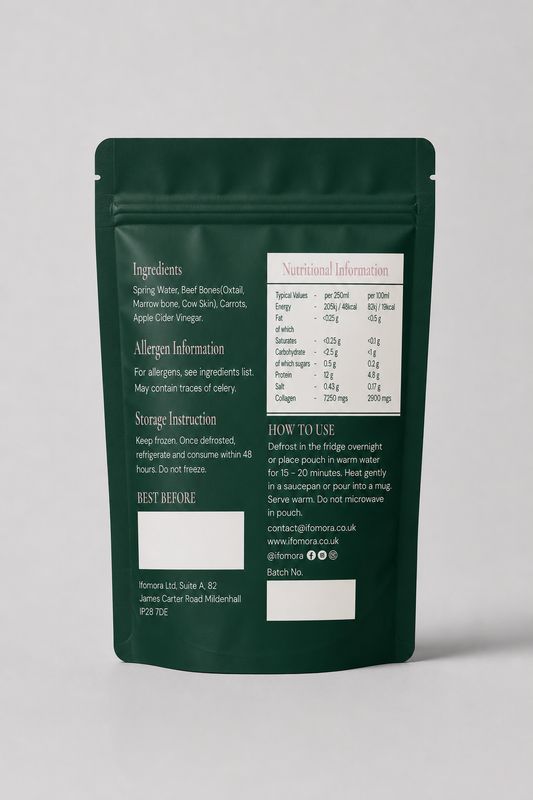
All three types are naturally present in bone broth made from quality beef bones — which is exactly what Ifomora is made from.
Why does collagen decline?
Your body produces collagen naturally throughout your life — but from around the age of 25, that production starts to slow down. By your mid-thirties, the decline becomes more noticeable. By your forties, your body may be producing significantly less collagen than it needs.
Several factors accelerate this decline:
- Age — the primary driver. Production slows naturally from your mid-twenties onwards.
- Sun exposure — UV radiation breaks down collagen fibres in the skin, accelerating visible ageing.
- Sugar and refined carbohydrates — excess sugar causes glycation, a process that damages and weakens collagen.
- Smoking — reduces blood flow to the skin and accelerates collagen degradation.
- Poor nutrition — collagen production requires adequate protein, vitamin C, and zinc. Without these, the body cannot produce or maintain it effectively.
The good news is that how you nourish your body has a direct impact on how well it maintains and replenishes its collagen levels. This is not something you are passive about. It is something you choose.
What are the benefits of collagen?
When your body has the collagen it needs, the benefits show up across multiple areas simultaneously. Here is what adequate collagen levels support:
- Skin firmness and elasticity — collagen is the structural protein beneath your skin. When levels are healthy, skin looks plump, bouncy, and firm. As collagen declines, skin loses that quality and fine lines become more visible.
- Joint comfort and mobility — collagen cushions your joints. People with healthy collagen levels tend to experience less stiffness and more comfortable movement, particularly in the knees, hips, and hands.
- Gut lining integrity — the wall of your digestive tract depends on collagen for its structure. Healthy collagen levels support a strong gut lining, which means better digestion, less bloating, and reduced sensitivity to food.
- Hair and nail strength — collagen provides the building blocks for keratin, the protein that makes up hair and nails. Many people notice stronger, faster-growing nails within weeks of increasing their collagen intake.
- Muscle support — collagen is a component of muscle tissue. It supports muscle mass and recovery, particularly after exercise.
- Bone density — bones are made partly from collagen, which provides their flexibility and strength. Adequate collagen is important for bone health alongside calcium and vitamin D.
What is the best natural source of collagen?
The most bioavailable source of collagen — the form your body can absorb and use most effectively — is whole food. Specifically, slow-simmered bone broth made from animal bones, joints, and connective tissue.
When beef bones are simmered for hours, the collagen within them breaks down into gelatine and amino acids that your body recognises as real nutrition. Unlike processed collagen powders, which are industrially hydrolysed and stripped of the wider nutritional matrix, bone broth collagen comes packaged exactly as nature intended — alongside the amino acids, minerals, and gut-supporting compounds that help your body actually use it.
This is why I built Ifomora around bone broth. Not as a trend. Not as a supplement in disguise. As a genuine daily wellness ritual built around one of the most honest sources of natural collagen available.
The simple truth about collagen.
Your body needs collagen. It produces less of it as you age. And the best way to support it is not with an expensive processed powder — it is with real food, consumed consistently, every day.
One warm mug of Ifomora bone broth every morning. That is it. Simple, intentional, and genuinely nourishing.
Wellness from within